
FaceRiff: Data-Efficient Unified Text-to-3D Face Asset Synthesis via Geometric Conditioning
Accepted to SIGGRAPH Asia 2026 Conference Papers, 2026
Recommended citation: Akhoundi, E.; Lamarre, M.; Goyallon, T.; Anderson, P.; Danvoye, É. (2026). FaceRiff: Data-Efficient Unified Text-to-3D Face Asset Synthesis via Geometric Conditioning. Accepted to SIGGRAPH Asia 2026 Conference Papers. arXiv:2611.21867. https://arxiv.org/abs/2611.21867
Elly Akhoundi, Mathieu Lamarre, Thibault Goyallon, Patrick Anderson, Étienne Danvoye
Accepted to SIGGRAPH Asia 2026 Conference Papers.
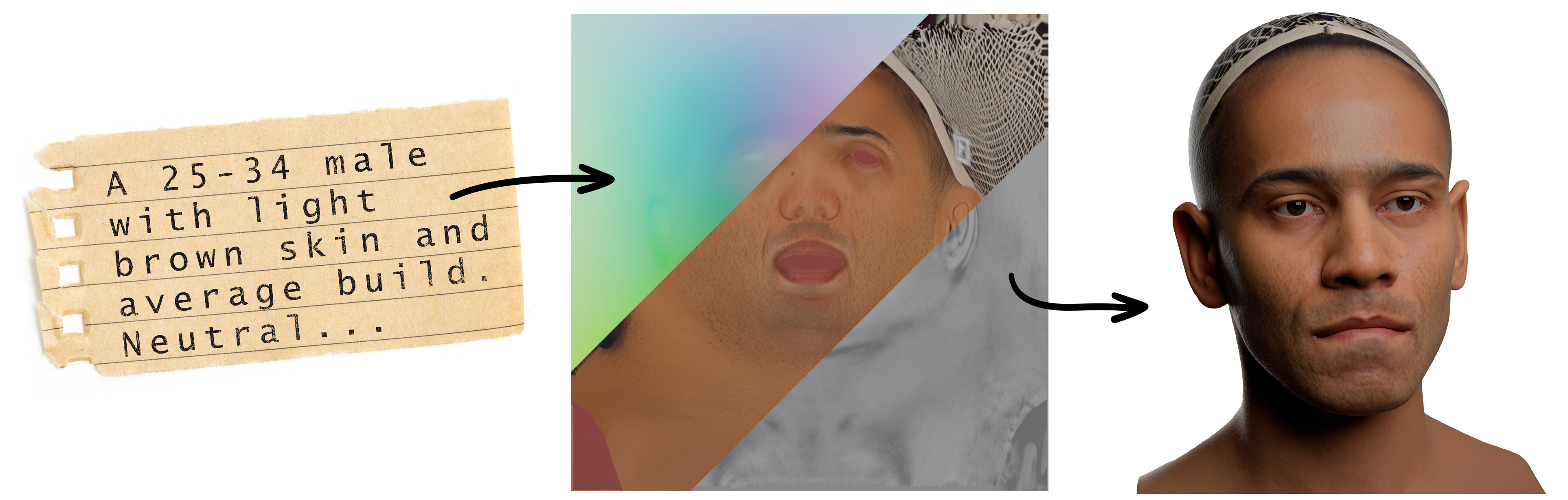
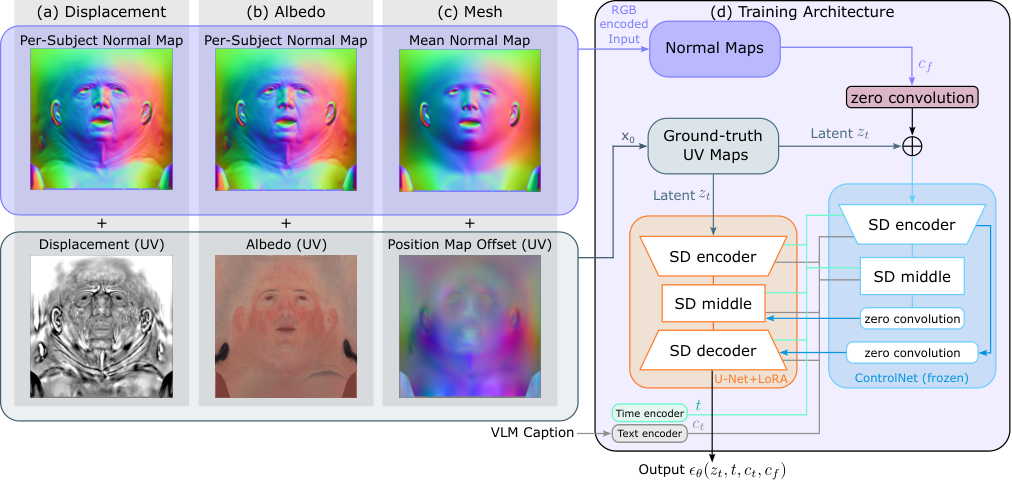
FaceRiff generates complete 3D face assets directly from text: a mesh, lighting-independent albedo, and fine-scale displacement, all aligned in a shared UV space. It adapts a pretrained SDXL diffusion model using task-specific LoRA adapters and UV normal maps for geometric conditioning.
Trained on 2,049 scans from approximately 350 identities using a single GPU, the framework updates less than 3% of the backbone parameters per task and produces assets ready for rendering without per-instance optimization.
Figures from Akhoundi et al., FaceRiff (2026), reproduced under CC BY-NC-ND 4.0.